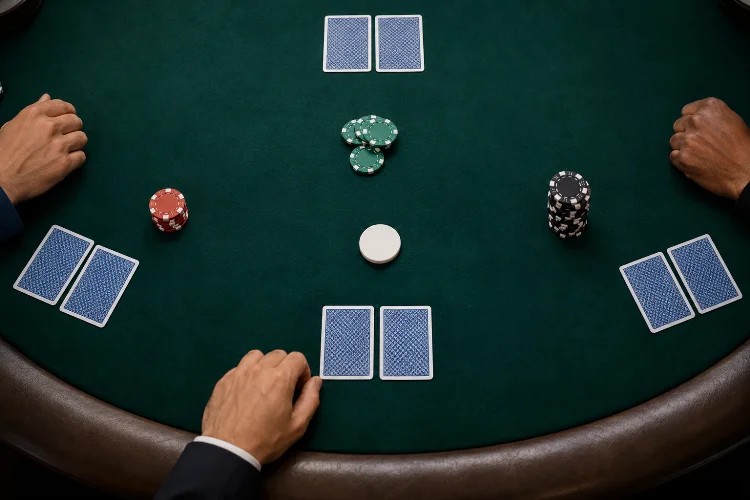
Poker can seem confusing before the cards are even dealt. Someone puts chips in the middle, another player adds a bigger forced bet, and a small round button moves around the table after every hand.
If you are new to the game, you might wonder why anyone is betting before seeing their cards.
That is where blinds, antes, and dealer buttons come in. These simple mechanics create action, determine table position, and make sure players cannot simply sit around waiting forever for pocket aces.
In games such as Texas Hold’em, understanding these concepts is just as important as knowing which hands beat which. They tell you who must put chips into the pot, who acts first, and who gets the valuable opportunity to act last.
Once you understand how the system works, the flow of a poker hand becomes much easier to follow. Let’s break down each part without making it more complicated than it needs to be.
What Are Blinds in Poker?
Blinds are compulsory bets placed before players see their hole cards. Their main purpose is to create money or chips in the pot so there is something worth competing for.
In a standard Texas Hold’em game, there are normally two blinds: the small blind and the big blind.
The player immediately to the left of the dealer button posts the small blind. The next player clockwise posts the big blind. PokerStars’ beginner material likewise describes these two forced bets as being positioned directly to the left of the button.
Suppose you are playing a $1/$2 cash game. The small blind would typically be $1 and the big blind $2.
Before anyone receives cards, those chips are already in the pot.
Because players are forced to pay blinds as the button rotates around the table, everyone eventually contributes. Without blinds, players could theoretically fold hand after hand without risking anything.
How the Small Blind and Big Blind Affect Betting
The size of the blinds does more than create the starting pot. It also establishes the minimum betting level for the hand.
Imagine a no-limit Hold’em game with blinds of $5/$10. Before the cards are dealt, the small blind contributes $5 and the big blind contributes $10.
Preflop action normally begins with the player immediately to the left of the big blind. That player can fold, call the $10 big blind, or raise. This structure is also reflected in established live-poker rules, where action on the opening betting round starts after the blinds.
Things change after the flop.
On the flop, turn, and river, action generally begins with the first active player clockwise from the button. As a result, players in the blinds often have to make decisions early on later streets.
That positional disadvantage is one reason playing from the blinds can be tricky.
What Is an Ante in Poker?
An ante is another type of forced contribution, but it works differently from a blind.
Traditional antes require every active player to contribute a small amount before the hand begins. Instead of only two players putting chips into the starting pot, everyone contributes.
For example, imagine a tournament where the blinds are 500/1,000 with a 100 ante. At a nine-player table, traditional antes would add another 900 chips to the pot before any voluntary betting occurs.
This creates more incentive for players to compete for pots.
Antes are especially common in tournament poker because they prevent the game from becoming too passive as stacks and blind levels change. They can also appear in certain cash games and are an essential feature of poker variants such as Seven Card Stud.
The important thing to remeber is that a blind and an ante are not exactly the same. A blind is associated with specific table positions, while a traditional ante is contributed by every participating player.
How the Big Blind Ante Works
Modern poker tournaments often use a system called the big blind ante, or BBA.
Instead of making every player individually post an ante, the player in the big blind contributes a single ante for the table. Poker TDA’s current recommended procedures favor the big blind ante format when a single-payer ante system is used.
Suppose a tournament level is listed as 1,000/2,000 with a 2,000 big blind ante.
The small blind posts 1,000. The big blind posts the regular 2,000 blind plus the 2,000 ante.
That means there are already 5,000 chips involved before voluntary action even begins.
The exact ante structure depends on the tournament, so players should always check the published blind schedule rather than assume the ante will have a particular size.
Why use one big blind ante instead of collecting tiny antes from everyone?
Efficiency is a major reason. Collecting chips from every player can slow the game, especially when someone forgets to post or needs change. Consolidating the ante makes the procedure much easier for dealers to manage.
What Does the Dealer Button Do?
The dealer button is the small circular marker that identifies the nominal dealer position.
In a casino, the player holding the button does not usually shuffle and deal the cards. A professional dealer handles that job. The button instead tells everyone where the hand’s positions begin and end.
After a hand finishes, the button typically moves clockwise to the next position. This movement ensures players take turns occupying the various positions around the table.
The button is especially important because poker is a game of information.
In Hold’em, the player on the button normally acts late after the flop. Seeing what other players do before making your own decision is extremely valuable.
Imagine three players reach the river.
If you are first to act, you must decide whether to check or bet without knowing what the others will do. If you are on the button and action checks to you, you already know both opponents declined to bet.
That extra information can completely change your decision.
This is why players often describe the button as one of the strongest positions at the table.
How Blinds and the Button Move Around the Table
Consider a six-player Hold’em table.
If Player 1 has the dealer button, Player 2 posts the small blind and Player 3 posts the big blind. Players 4, 5, and 6 then act before Player 1 and the blinds during the preflop round.
When that hand ends, the button ordinarily moves clockwise.
Player 2 now receives the button, Player 3 becomes the small blind, and Player 4 becomes the big blind.
Over time, everyone moves through the same positions.
This rotation matters becuase position creates both advantages and disadvantages. Being on the button usually gives you valuable information after the flop, while being in the blinds forces you to invest chips before seeing your cards.
Tournament procedures can become more complicated when players are eliminated or tables are balanced. Poker TDA rules, for example, include specific procedures for button movement, dead buttons, and player movement between tables.
What Happens When Only Two Players Remain?
Heads-up poker has a special blind arrangement that frequently confuses beginners.
When only two players remain, the player with the dealer button posts the small blind, while the other player posts the big blind.
The button acts first before the flop.
After the flop, however, the button acts last.
Poker TDA rules explicitly specify this heads-up structure: the small blind has the button, receives the last card, acts first preflop, and acts last on the remaining betting rounds.
At first, this can seem backwards compared with a full table. But the arrangement keeps the positional rotation fair and maintains the correct betting sequence.
If you are playing your first heads-up game, this is one of those rules worth double-checking before dealing the next hand.
Why Blinds and Antes Increase During Tournaments
Cash-game blinds usually remain at the same level unless the game itself changes stakes.
Tournament poker works differently.
Blind levels increase according to a predetermined schedule. Antes may also be introduced or increased as the tournament progresses.
For example, a tournament might begin at blinds of 100/200 and later move through 200/400, 500/1,000, 1,000/2,000, and much higher levels.
This creates pressure.
If blinds stayed tiny forever, players with large stacks could simply wait for premium hands for extremely long periods. Increasing forced bets gradually reduces stack sizes relative to the blinds and encourages more action.
Players often measure their stack in big blinds for this reason.
A 50,000-chip stack sounds large, but its real meaning depends on the current blind level. At 500/1,000, you have 50 big blinds. At 5,000/10,000, that same stack contains only five.
Understanding this relationship is extremely usefull when deciding how aggressively you need to play.
Why These Rules Matter for Poker Strategy
Blinds, antes, and the button are not just administrative details. They influence almost every strategic decision you make.
When you are on the button, fewer players remain behind you, and you will usually have positional advantage after the flop. That can make raising with a wider range of hands more attractive.
When antes are involved, there is more money in the pot before the hand begins. Winning the pot without reaching a flop can therefore become more valuable.
The blinds create another pressure. Folding every big blind without resistance means gradually surrendering chips to opponents.
This is where concepts such as stealing the blinds come from. A player in late position may raise partly because they expect the remaining players to fold, allowing the raiser to collect the forced bets without seeing a flop.
You do not need to master advanced strategy immediately. Just understand that table position and forced bets are closely connected to good poker decisions.
Understanding blinds, antes, and dealer buttons makes poker much easier to follow.
The small and big blinds create an initial pot, while antes add additional chips and encourage players to compete more actively. The dealer button rotates around the table and determines both blind positions and much of the betting order.
Tournament structures add another layer because blinds and antes usually increase over time, while formats such as the big blind ante simplify how forced contributions are collected.
Before worrying about complicated poker strategy, get comfortable identifying the button, small blind, big blind, and current ante structure.
Next time you watch or play a hand, follow these positions from start to finish. After a few rounds, the system will feel far less confusing – and you can start focusing on the decisions that really matter.