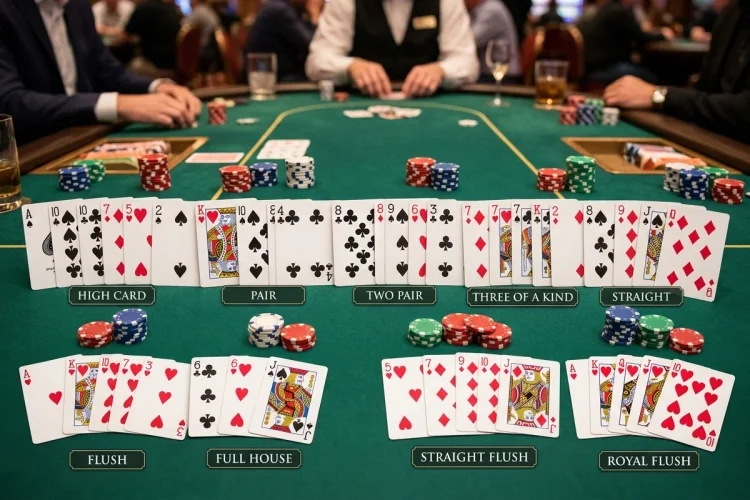
You look down at your cards, glance at the table, and see a pair. Great-but is that actually a strong hand? What if another player has two pair? Does a straight beat a flush? And what exactly makes a Royal Flush so special?
Understanding poker hand rankings answers all of these questions.
Whether you are learning Texas Hold’em, Five-Card Draw, or another game using traditional high-hand rules, knowing which combinations beat others is one of the first skills you need. Standard rankings run from High Card at the bottom to Royal Flush at the very top.
Fortunately, the ranking system is easier to memorize than it initially appears. Most hands are based on three simple ideas: matching card ranks, creating numerical sequences, and collecting cards of the same suit.
In this guide, we will walk through every standard poker hand from weakest to strongest, explain how ties are settled, and use practical examples so you can recognize winning hands faster.
Poker Hand Rankings at a Glance
Traditional poker uses a five-card hand to determine the winner. In games such as Texas Hold’em, you may have seven cards available-two private hole cards and five community cards-but only your best five-card combination counts.
The standard poker hand order, from weakest to strongest, is:
- High Card
- One Pair
- Two Pair
- Three of a Kind
- Straight
- Flush
- Full House
- Four of a Kind
- Straight Flush
- Royal Flush
PokerStars and PokerNews list the same traditional ranking order for games such as Texas Hold’em.
In general, rarer combinations rank above more common ones. That is why a Full House beats a Straight and why an extremely rare Royal Flush sits at the top of the chart.
High Card, One Pair, and Two Pair
1. High Card
A High Card hand occurs when your five cards do not form any stronger combination.
For example:
A♠ J♦ 9♣ 6♥ 3♠
There is no pair, straight, or flush, so the ace determines the basic strength of the hand. An ace-high hand beats a king-high hand.
If two players both have ace-high, you compare the second-highest card, then the third, and so on until the tie is broken.
High Card is the weakest standard poker hand. That does not mean it never wins, though. If everyone reaches showdown without making a pair or better, the highest five-card combination takes the pot.
2. One Pair
One Pair means having two cards of the same rank plus three unmatched cards.
Example:
J♠ J♥ 9♦ 5♣ 2♥
This hand is called a pair of jacks.
When two players have One Pair, the higher pair wins. If both hold the same pair, the remaining cards-called kickers-are compared from highest to lowest.
3. Two Pair
Two Pair consists of two different pairs plus one additional card.
For example:
K♠ K♦ 7♣ 7♥ A♣
This is kings and sevens with an ace kicker.
When comparing two Two Pair hands, check the higher pair first. If those are equal, compare the second pair. If both pairs match, the kicker decides the winner.
Three of a Kind, Straight, and Flush
1. Three of a Kind
Three of a Kind contains three cards with the same rank.
Example:
8♠ 8♦ 8♣ K♥ 4♠
In Texas Hold’em, you may hear players use the words set and trips. A set commonly refers to making Three of a Kind with a pocket pair and one matching community card, while trips usually involves one hole card matching a paired board.
Regardless of the terminology, Three of a Kind beats Two Pair, One Pair, and High Card.
2. Straight
A Straight contains five cards in consecutive numerical order, but they do not all need to share the same suit.
Example:
6♠ 7♦ 8♣ 9♥ 10♣
A useful rule for beginners concerns the ace. It can sit above a king in an A-K-Q-J-10 straight or act as the low card in A-2-3-4-5. The latter is often called a wheel.
If two players have Straights, the one ending with the higher card wins.
3. Flush
A Flush contains five cards of the same suit that are not in consecutive order.
Example:
A♥ J♥ 8♥ 5♥ 2♥
A Flush beats a Straight, even though beginners sometimes assume a sequence should be stronger.
When two Flushes compete, compare their highest cards. If those match, move to the next-highest card until the winner is determined.
Full House and Four of a Kind
1. Full House
A Full House combines Three of a Kind with One Pair.
Example:
Q♠ Q♥ Q♦ 6♣ 6♥
This would be described as “queens full of sixes.”
A Full House beats a Flush and everything below it but loses to Four of a Kind, a Straight Flush, or a Royal Flush.
There are 3,744 possible Full House combinations among the 2,598,960 possible five-card hands from a standard 52-card deck, illustrating why this combination is significantly less common than many lower-ranked hands.
When comparing two Full Houses, look at the Three of a Kind component first. Therefore, K-K-K-2-2 beats Q-Q-Q-A-A.
2. Four of a Kind
Four of a Kind, often called quads, means four cards share exactly the same rank.
Example:
9♠ 9♥ 9♦ 9♣ K♥
Only Straight Flushes and Royal Flushes rank above Four of a Kind under traditional high-hand rules.
If two players somehow share the same quads in a community-card game, the remaining kicker may determine the winner.
Straight Flush and Royal Flush
1. Straight Flush
Now we reach the truly rare hands.
A Straight Flush combines the characteristics of both a Straight and a Flush: five consecutive cards, all belonging to the same suit.
Example:
5♦ 6♦ 7♦ 8♦ 9♦
A higher Straight Flush beats a lower one. For example, a jack-high Straight Flush defeats a nine-high Straight Flush.
In a random five-card hand from a standard 52-card deck, a non-royal Straight Flush is extraordinarily uncommon. Poker.org calculates its probability at about 0.00139%.
2. Royal Flush
The legendary Royal Flush is the highest version of a Straight Flush:
10♠ J♠ Q♠ K♠ A♠
All five cards must share the same suit. Hearts, diamonds, clubs, and spades are equally valuable; the suit itself does not make one Royal Flush stronger than another under traditional rules.
There are only four possible Royal Flush combinations in a standard 52-card deck-one for each suit. For five randomly drawn cards, Poker.org calculates the probability at about 0.000154%, or roughly one Royal Flush per 649,740 hands.
That rarity helps explain its famous status. Under traditional high poker rankings, nothing beats a Royal Flush.
How Poker Tie-Breakers Actually Work
Knowing the rankings is only half the job. Beginners also need to understand what happens when two players have the same type of hand.
Suppose Player A has:
A♣ A♦ K♠ 9♥ 5♣
and Player B has:
A♥ A♠ Q♣ J♦ 8♠
Both players have a pair of aces. Player A wins because the king kicker beats Player B’s queen.
The same principle applies differently depending on the category. Straights are compared by their highest card, Full Houses by their Three of a Kind component first, and Four of a Kind by the rank of the four matching cards before considering a kicker when necessary.
If both players have exactly the same best five-card hand in a community-card game, the pot is split.
Suits normally do not break ties. A flush in spades is not automatically stronger than an equivalent flush in hearts. Standard poker treats suits as equal in hand ranking.
The Easiest Way to Memorize Poker Hands
Instead of trying to memorize ten unrelated combinations, think of the rankings as a progression.
Start with matching cards:
High Card → Pair → Two Pair → Three of a Kind
Then remember the middle combinations:
Straight → Flush → Full House
Finally, memorize the three powerhouse hands:
Four of a Kind → Straight Flush → Royal Flush
One especially important detail is that a Flush beats a Straight. This is one of the most common points of confusion for new players.
Practice is even more effective than memorization. Take a regular deck, deal yourself five cards repeatedly, and identify the resulting hand. You can also look at sample Texas Hold’em boards and practice choosing the best five cards from seven available cards.
After enough repetition, recognizing a Full House, Straight, or Flush becomes almost automatic.
Remember That Some Poker Variants Use Different Rankings
The list above represents traditional high poker hand rankings used in standard games such as Texas Hold’em. However, not every poker variation follows exactly the same system.
For example, Short Deck Hold’em can use a modified ranking structure, while lowball games are specifically designed around making lower hands. Games involving wild cards may even allow Five of a Kind.
That means you should always check the rules of the specific poker variant before playing.
For a beginner learning Texas Hold’em, though, the traditional High Card-to-Royal Flush chart is the one to memorize first.
Learning poker hand rankings is one of the simplest ways to become more confident at the table. Remember the basic progression: High Card, One Pair, Two Pair, Three of a Kind, Straight, Flush, Full House, Four of a Kind, Straight Flush, and finally Royal Flush.
Pay attention to tie-breakers too. Two players can hold the same category of hand while different kickers, pair values, or high cards determine the winner.
You do not need to memorize everything in one sitting. Keep a hand-ranking chart nearby, practice identifying five-card combinations, and test yourself with sample hands.
Once the rankings become second nature, you can focus on the more interesting parts of poker-betting decisions, position, probability, and strategy.